History of Financial District, San Francisco
A Brief History of the Financial District
It is one of the many San Francisco. It is San Francisco's central business district. Even though an earthquake and fire almost wiped the entire area, most of its skyscrapers survived. Today, the architecture brings about contemporary and historic buildings such as the Bank of America, the merchant, and the Exchange building. Most corporate headquarters are based here, real estate firms, banks, law firms, and insurance companies. San Francisco's most prominent companies are found in the financial district; wells Fargo, electric company, Charles Schwab, McKesson, gap, and pacific gas.
Financial District Location
Close to the financial district is union square found on the west. To the northwest of the financial district lies Chinatown, and in the north, you find the north beach. You will find Embarcadero to the east, and the south lies SoMa district.
Transport network
The district has about two dozen rails lines and Muni bus. The BART system is also a primary connecting system, as well as a single cable car. You can also use a taxi to navigate around the district. Taxis are mostly found on the exists of stores, some skyscrapers, and hotels.
The district is home to many corporate headquarters, including the fortune 500 companies situated in California. The headquarters of the 12th district is located here as well. The district has several malls such as ferry Building Marketplace, Crocker Galleria, and the Rincon Centre complex.

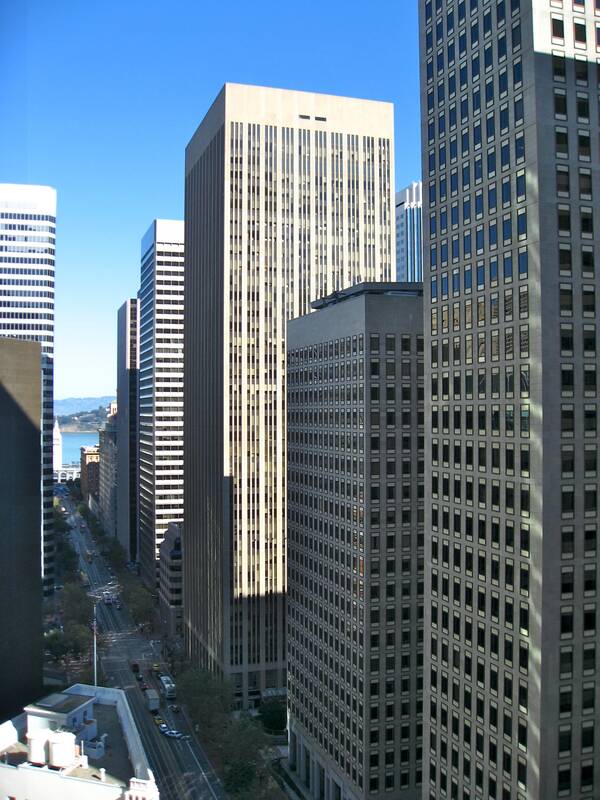
Tall buildings in the Financial District are shown above in the picture. These types of buildings are pretty much exclusive to this area of San Francisco.
Financial District History
The 1906 earthquake destroyed the financial district, although the skyscrapers survived the catastrophe. The rebuilding began immediately, and as by 1910, the area had low rise building having six to twelve stories. At the end of 1930, buildings such as Russ building, Standard Oil Building, Shell Building, and Hunter Dulin Building were already constructed. Due to the height restrictions imposed for fear of earthquakes, the district maintained a low-rise level building until the late 1950s. The restrictions were lifted courtesy of the invention and implementation of earthquake retrofitting technology. The technology saw a spike of skyscraper buildings all over the district. All this happened under the leadership of Mayor Dianne Feinstein.
The mayor's critics brought a lot of criticism and led to skyscraper revolt, which saw the city impose stringent skyscrapers measures.
Manhattanization
This is a coined word used to describe taller buildings' construction, transforming a city's characteristics. During the mayor Dianne Feinstein's tenure in the financial district, her critics used this term to condemn her for allowing the construction of tall buildings. They claimed the buildings would block the bay area's view and the hills surrounding the bay area. However, the term gained popularity as tall buildings continued to be built in the Financial District. Generally, there over 160 buildings taller than seventy-three meters in san Francisco.
Reports given by the Tri commercial shows that traditional financial district offers approximately 2,800,000 m2 of office space. The south Financial district offers 2,600,000 m2 of office space. When the two combine, they employ over 220,000 office workers.
Due to the sheer size of the denes population in the financial district there are bound to be breakdowns and accidents with vehicles. If you need a financial district towing service we are always here to serve you with our experienced tow truck drivers.